
The Political and Social Economy of Labor Migration: An Introduction

March 20, 2026
For centuries, migration has toggled between being seen as an opportunity for some and a curse for others. From the fifteenth to the nineteenth centuries, migration from Europe to South and Southeast Asia, North and South America, and Africa offered new resources, land, and opportunity to European immigrants. But these same migration flows meant conquest, land dispossession, disease, violence, and (in some cases) total cultural annihilation for native populations in the receiving countries. During the eighteenth and nineteenth centuries, forced migration from Africa and South Asia to other parts of Africa, Asia, and especially the Americas brought wealth to settlers in the receiving nations, but inhumane violence and degradation to the migrants themselves, not to mention to generations of those migrants’ descendants. Today, we are witnessing another version of the same conundrum. For billions of people, migration offers the only chance for economic survival and/or physical safety. Yet these same migration flows are creating deep insecurities and angst for billions of natives. These tensions are leading country after country into right-wing coalitions fueled by hatred. It is time we offered a set of new analytical lenses to examine the migration question, and sociologists are well poised to take on this challenge.
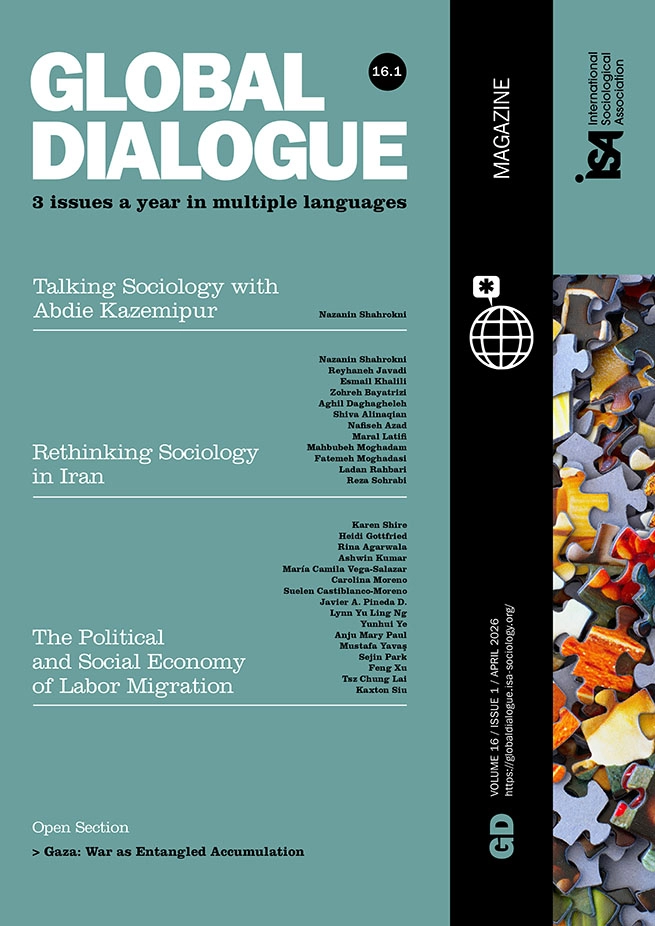
This special section advances sociological analyses of the political and social economy of labor migration by focusing on states, policies, actors, and the challenges posed to persons who seek to improve their livelihoods through mobility, both internally and across national borders. The articles that follow build on contributions originally presented at the conference on the “International Political Economy of Migrant Labor” sponsored by the International Sociological Association’s Research Committee on Economy and Society (RC02) and the World Society Foundation at the University of Duisburg-Essen in the summer of 2024. They address sending states and policies of out-migration; capital for foreign investment; the complex intersections of rural-to-urban and cross-border migration, especially from and to the Global South; comparisons of sending and receiving states; educated and low-wage migration; and how all these shape migrants’ expectations and life trajectories. Countries featured span a wide sociopolitical geography, revealing complex intraregional and transnational migration flows across the world system.
Analyzing migration-development regimes
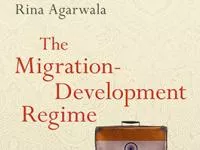
An important innovation in the sociological analysis of migration is the shift to conceptualize the role and consequences of labor migration for sending states where economic, social, and political transformation becomes tied to migration in what Agarwala calls the “migration-development regime.” As summarized in the lead article by Agarwala, three questions inform the study of migration-development regimes in India, where Agarwala originally developed the concept, and in other contexts in the developing world: first, who benefits from migration; second, what are the consequences of migration; and third, how the nexus between migration and development is constantly changing.
Exposing who benefits from migration may contribute to positively shaping public opinion about and support for migration. Scrutinizing the consequences of migration, especially in relation to social class hierarchies and elite coalitions, can yield insights into migration as a model of growth and its effects on social protections. Finally, studying how migration-development regimes change over time can yield alternative imaginaries of how migration can benefit social development.
In studying out-migration from India to lower-wage sectors abroad, Kumar examines whether bilateral agreements existed between sending and receiving states, a practice promising, at least nominally, to ensure safe and orderly migration. Kumar finds that these agreements fail to adequately consider the health and safety of Indian outmigrants, in part because they neglect to consult and enable the participation of migrant organizations and labor unions in developing protections. For the Indian state, out-migration serves multiple purposes, promoting economic development, while securing political legitimacy both at home and abroad, and achieving consent for a new neoliberal habitus.
Domestic and care labor migration
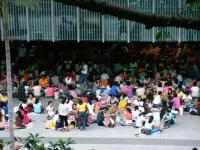
Sociological work on migrant mobilities has long traced the consequences of care migration, both for communities of origin left with care gaps, and for social inequalities in destinations where exploitative working conditions are rooted in global social and ethnic hierarchies. The series of papers on domestic and care migration engages in transnational comparisons of mobilities within the Global South and comparisons between rural-to-urban and cross-border migrations.
Vega-Salazar, Moreno, Castiblanco-Moreno and Pineda show how South-to-South mobilities of women in Latin America deviate systematically from South-to-North flows, which have dominated research on care migration. Global care chains are not simple transfer systems of reproductive labor. The large population of Venezuelan women migrating to Colombia carry their care obligations at home with them when they migrate with their children and other dependent adults. In the care work sector, however, displaced Colombian women are also strongly present, while the irregular migration and informality common in the sector affects the working conditions and livelihood security of Venezuelan migrant women.
Ng and Ye compare patterns within East and Southeast Asia, between the rural-to-urban care migration within the People’s Republic of China and the transnational migration of domestic laborers from lower-income countries to Singapore. Ideologies of “mobile developmentalism” operate very similarly in both contexts to situate mobile and migrant domestic laborers as less modern, and thus less worthy of decent work and fair treatment by the modern urban families for whom they work.
Questioning assumptions about educated and skilled migrants
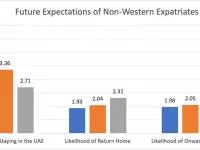
Two contributions focus on analyses of educated and skilled migrants, still relatively neglected in migration scholarship. This is especially true for research on migration to the Gulf States. Paul, Yavaş, and Park discuss the findings of their research on expatriate migrants from the Middle East and North Africa (MENA) and South Asia to Dubai: a destination preferred over the usual Global North labor markets. While career development and living standards in Dubai do not deviate from Global North contexts, expatriates from the MENA region and South Asia view geographic proximity enabling easy family visits and tolerance for religious and ethnic identities, as rendering Dubai a preferred destination over the Global North. This condition does not, however, apply to migrants from Sub-Saharan Africa, who experience discrimination in Dubai not unlike that experienced in the Global North. Global cities like Dubai are sites for the incorporation of large numbers of low-paid immigrants serving elite expats, creating a precarious feminized economy of reproductive services.
Xu compares the motivations of migrants from China, who are mobile both internally and cross-nationally to Canada for education. Research has assumed that citizenship in Canada and urban “hukou” registration status in China are major motivations for educational migration cross-nationally and domestically. On the contrary, Xu finds that rural education migrants are more interested in the better job prospects in the urban Chinese labor markets after graduation than in a different registration status (hukou). Chinese education migrants to Canada prefer permanent residency to citizenship, as do Chinese who have migrated from rural regions in China to Canada, as foreign citizenship could restrict their mobility back to China and their capacity to live transnationally.
The case of Chinese influence in Cambodia
The final article by Lai and Siu focuses specifically on how Chinese foreign direct investment in Cambodia, accounting for 90% of the garment industry and 55% of all foreign-owned factories, strengthens a model of authoritarian capitalism in Cambodia where economic growth reliant on foreign investment is prioritized over labor rights and democratic participation. While Cambodian garment workers continue to struggle against exploitation, the incidence of strikes has dropped sharply as the country aims to deliver cheap labor to attract and placate Chinese investors. The migration development regime that emerges resembles earlier research on dependent development in Latin America and other Southeast Asian contexts.
Ideologies and policies affect whether migration offers social mobility or merely strengthens existing hierarchies
New avenues for future sociological research on migration suggested by these papers point to the importance of states – sending and receiving – and their development and investment models for shaping whether migration opens up chances for social mobility and livelihood security, or results in trapping already vulnerable migrants in precarious livelihoods. Social class, as well as gender and ethnicity, especially when the latter overlaps with differences in income levels of countries of origin and destination, strongly shapes these possible consequences of migration. Though educated migrants are most likely to experience benefits, this depends on their integration or exclusion from labor markets in their destinations.
Development ideologies and policies matter for whether migration presents an opportunity for social mobility or for cementing gender, class, and ethnic hierarchies. International governance for safe and orderly migration, however, has not yet delivered equity and protection for migrants in low-wage work. Also, policies in destination countries do not yet offer skilled migrants the social and political protections they seek. The consequences of migration in relation to bordering and questions of inclusion and exclusion are very similar for internal and transnational migration, which intersect in sectors like domestic and care labor and low-skilled manufacturing. South-to-South migration and the confluence of both out-migration and immigration in a growing number of contexts underscore the need for more research on the institutions and practices that shape the experiences of migrants globally.
Karen Shire, University of Duisburg-Essen, Germany <karen.shire@uni-due.de>
Heidi Gottfried, Wayne State University and Russell Sage Foundation, USA <ag0921@wayne.edu>
Rina Agarwala, Johns Hopkins University, USA <agarwala@jhu.edu>