
Caring Across Borders: Venezuelan Migrant Women in Colombia
March 20, 2026
At the turn of the twenty-first century, sociologist Arlie Hochschild introduced the notion of global care chains – transnational networks of women transferring care responsibilities across borders, typically from poorer countries to wealthier ones. This concept sparked a robust academic field analyzing how gender, class, and migration intertwine with caregiving. Much of the literature has centered on South–North migration: women from the Global South moving to wealthier nations to meet growing care demands. But what happens when care chains operate within the Global South? Latin American scholars have been examining just this, revealing complex patterns of migration and caregiving across countries such as Chile, Brazil, Argentina, and, most recently, Colombia.
This article shifts the focus to South–South migration, using the case of Venezuelan women who have migrated to Colombia in massive numbers since 2015. As of late 2023, nearly 2.9 million Venezuelans had moved to Colombia, with women slightly outnumbering men. Many of these women are not only navigating precarious immigration policies and hostile labor markets but also shouldering paid and unpaid caregiving roles.
Our central argument is that global care chain theory must be revised to reflect the realities of regional, feminized, and often circular migration flows in the Global South. These care dynamics do not always follow the same patterns observed in wealthier countries. For example, migrant women often travel with their children, form multi-generational households in the destination country, or continue caregiving within their own families. In these contexts, care work is reconfigured, not simply transferred.
Care work in Colombia: a complicated landscape
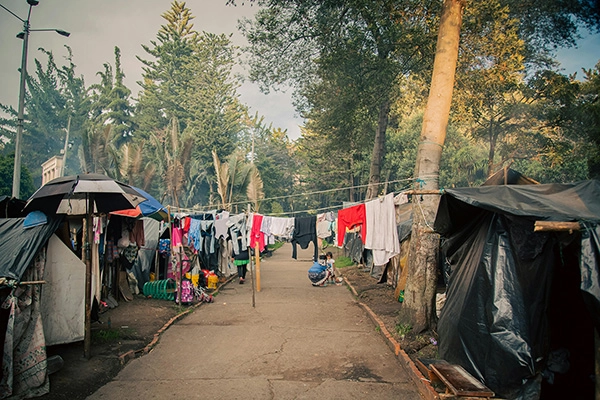
Colombia has long been shaped by internal displacement caused by armed conflict, contributing to a large population of women who work in informal care and domestic sectors. Now, the country is also a major destination for international migrants, particularly Venezuelan women.
Initially, the Colombian government responded to the Venezuelan influx with humanitarian relief. Later, it introduced mechanisms for legal regularization, notably the Temporary Protection Permit (PPT), which offered access to work and basic services. However, administrative delays, shifting political will, and limited enforcement have left many migrants undocumented and vulnerable to labor exploitation.
This is especially true in the care economy. Using data from Colombia’s official household survey (GEIH), we find that, despite having relatively high levels of education, Venezuelan women are overrepresented in low-wage, informal sectors like hospitality, food service, and retail. Surprisingly, domestic work is not the primary sector for these women. That role is largely filled by internally displaced Colombian women, reflecting how Colombia’s internal conflicts have shaped its own care labor market.
Venezuelan women working in domestic roles tend to be younger and more educated than their Colombian counterparts, yet they face higher rates of informality and exclusion from social protections. For example, 40% of Venezuelan domestic workers had no health coverage in 2023, and only 7% were affiliated with retirement savings systems, despite full-time workloads. Most have only oral labor contracts, further exacerbating their precarious status.
Beyond the numbers: a feminist critique
Our study urges a more intersectional approach to analyzing care work. Gender is not the only variable at play. National origin, legal status, race, age, and education all intersect to shape how care responsibilities are distributed, and who gets excluded.
The Venezuelan case also raises questions about the sustainability of current migration and labor policies. Colombia’s shift from humanitarian assistance to “socioeconomic integration” has yet to be realized in the form of meaningful protections or opportunities for migrant women. More recently, political shifts have led to calls for voluntary returns to Venezuela, despite the ongoing instability there.
We argue that instead of relying on temporary permits and political discretion, countries like Colombia need robust, permanent migration policies that recognize the value of caregiving work and ensure rights for those who provide it, regardless of their documentation status.
Rethinking care chains in the Global South
This research adds to a growing body of Latin American scholarship that challenges Eurocentric models of care migration. Rather than assuming a one-way flow of labor from South to North, we must acknowledge the dynamic, multi-layered realities of care in regional contexts. In Colombia, care is both exported and imported: while many Colombians have fled the country as migrants, the nation is also hosting a large influx of care workers from abroad.
Moreover, care in the Global South is often shaped by displacement, inequality, and state neglect. It is not just a matter of employment but of survival and solidarity among women. Care is distributed through informal networks, family arrangements, and communal strategies, often without state support.
Venezuelan women in Colombia are reframing what it means to be a migrant and a caregiver. Their experiences challenge simplistic models of global care chains and invite us to see care not just as labor, but as a site of political struggle and social transformation. By documenting these realities, this study calls for a more grounded, inclusive sociology of migration and care, one that centers the voices and agency of women navigating life on the move.
María Camila Vega-Salazar, Universidad de los Andes, Colombia <mc.vega611@uniandes.edu.co>
Carolina Moreno, Universidad de los Andes, Colombia <camoreno@uniandes.edu.co>
Suelen Castiblanco-Moreno, Universidad de La Salle, Colombia <secastiblanco@unisalle.edu.co>
Javier A. Pineda D., Universidad de los Andes, Colombia <jpineda@uniandes.edu.co>