
Cambodian Garment Migrant Workers: Precarity and Protest
March 20, 2026
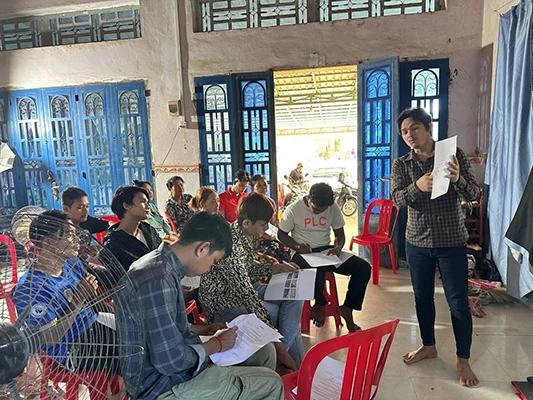
On March 9, 2024, approximately 600 Cambodian rural migrant workers from the Chinese-owned Y&W Garment Company marched to the Ministry of Labor and Vocational Training. They submitted a petition demanding unpaid wages and benefits after the company’s owner abruptly declared bankruptcy, leaving them without their final month’s salary. Later that afternoon, the ministry issued a statement urging workers, legal representatives, local unions, and other stakeholders to end their protest immediately, accusing them of obstructing traffic and causing congestion. The ministry advised the workers to seek redress through legal channels, emphasizing the importance of “maintaining public order and protecting the interests of the wider community.”
The sudden bankruptcy of Y&W Garment Co. Ltd. and the resulting unpaid wages starkly illustrate the precarious conditions faced by Cambodian rural migrant garment workers within the evolving landscape of foreign investment. Simultaneously, the workers’ collective protest not only exposes their vulnerability but also demonstrates their capacity to mobilize and assert agency amid escalating exploitation and insecurity. The rapid expansion of Chinese-owned factories, coupled with such acts of worker resistance, raises urgent questions for labor and industrial sociologists: What is the current situation for Cambodian rural migrant garment workers amid the overwhelming presence of Chinese capital? Importantly, how are workers responding to the challenges and hardships imposed by poor working conditions and economic uncertainty? What is the Cambodian government’s stance on this situation?
Workers’ multifaceted precarity
When examining the current circumstances of Cambodian rural migrant garment workers, multiple and intersecting forms of precarity become apparent. Based on our 2023-2024 survey of 86 workers from 28 garment factories, it is evident that these workers face acute job insecurity, driven by subsistence-level wages (US$204/month), widespread short-term contracts (with 66% on contracts of six months or less), and pervasive age-based discrimination – workers over 40 are particularly susceptible to layoffs and exclusion. Factories routinely enforce rotational suspensions, paying workers as little as US$40/month during periods of order shortages, perpetuating cycles of financial instability and uncertainty. The industry’s deep integration into buyer-driven global value chains enables international brands to shift the risks of fluctuating demand and production onto the most vulnerable: the workers themselves.
Precarity extends well beyond the factory gates, shaping migration patterns and household survival strategies. A significant 77% of workers are rural migrants, and dual incomes are essential for survival: 75% of married couples co-reside in Phnom Penh, yet basic living costs (US$300/month for two people) exceed typical wages. To cope, many families leave children in their home villages (37%), relying on grandparents for childcare and, in times of crisis, on reverse remittances; 31% of workers receive support from rural families. Debt is widespread and crippling (median: US$4,250), often secured against land, eroding workers’ long-term security and perpetuating cycles of malnutrition and intergenerational poverty as wages consistently fail to meet even the most basic needs. These debts originated from underemployment during the Covid period, as workers struggled to make ends meet in Phnom Penh’s high-cost environment. Additionally, some rural migrant workers borrow money to purchase motorbikes and fuel to commute between rural and urban areas, especially those who leave their children and elderly relatives behind in their rural hometowns.
Authoritarian capitalism and the Cambodian state’s response
The government’s reaction to the Y&W protest exemplifies Cambodia’s authoritarian turn in labor relations. By framing the demonstration as a threat to public order, the state signals a tightening grip on labor activism, consistent with a regional trend toward authoritarian capitalism: economic growth and foreign investment are prioritized over labor rights and democratic participation.
Although Cambodian rural migrant workers have a history of collective resistance, their space for action has narrowed dramatically. According to Better Factories Cambodia, strikes plummeted from 147 in 2013 to just 9 by August 2018, with lost workdays dropping from nearly 889,000 to 42,000. Labor disputes referred to the Arbitration Council fell from 248 in 2016 to 50 in 2017. This decline is less indicative of improved labor relations than a consequence of systematic state suppression: arresting union leaders, intimidating activists, and co-opting trade unions as government allies, especially since the 2013 election.
The legal framework for organizing has been steadily eroded, and independent dispute resolution is increasingly rare. The government’s rhetoric – emphasizing “public order” and “community interests” – serves to obscure a deeper reality: the interests of capital, both domestic and foreign, are privileged over the well-being and rights of workers.
Precarity and the possibility of resistance
The Y&W Garment protest offers a stark window into the multifaceted precarity and constrained agency of Cambodian rural migrant garment workers under authoritarian capitalism. While Chinese investment has fueled economic growth and job creation, it has also entrenched a system where risk and insecurity are borne almost entirely by workers. As of October 2024, Chinese capital accounts for approximately 54.7% ownership of Cambodia’s 2,236 industrial factories, representing an impressive investment of US$9.086 billion. Most strikingly, Chinese investors now control around 90% of all garment factories in Cambodia.
This dramatic shift illustrates China’s evolution from the “world’s factory” to a leading global investor. Rising domestic labor costs prompt Chinese firms to relocate production to countries like Cambodia, where low wages offer a distinct competitive advantage. The dominance of Chinese capital in Cambodia’s key industries compels the Cambodian state to align itself with capital interests. This alignment – evident in its suppression of labor activism and emphasis on “public order” – has further narrowed the space for collective bargaining and worker-led change.
Yet, the resilience of Cambodian rural migrant workers endures. Their willingness to protest, reliance on family and community networks, and ongoing struggles for fair wages and decent conditions all speak to a powerful spirit of resistance. The path forward will require new forms of solidarity and advocacy – both within Cambodia and across borders – to counter the deepening precarity imposed by global capital and authoritarian governance. The Cambodian case is a vivid reminder that the future of work in a globalized world will be shaped by the ongoing contest between capital’s demands and workers’ struggles for dignity, security, and justice.
Tsz Chung Lai, Hong Kong Baptist University, Hong Kong <22482261@life.hkbu.edu.hk>
Kaxton Siu, Hong Kong Baptist University, Hong Kong <kaxton_siu@hkbu.edu.hk>