
Sociological Contributions to the Migration Challenge
March 20, 2026
Global migration is among the greatest challenges of our century. The topic itself is determining election results, and people’s views on the issue are dividing countries, communities, and even families. How can sociology help address this challenge?
For decades, sociologists have helped redirect our gaze from simply looking at individual migrants to also understanding the broader economic and social forces catalyzing internal and global migration flows in the first place. Understanding these structural factors has helped illuminate who migrates, how and where they migrate, and why they migrate despite the costs and risks involved. For example, sociologists have analyzed the different “push factors” – such as economic poverty, disease outbreaks, land dispossession, and violence – that urge certain populations to make the difficult and often dangerous decision to leave their homes and loved ones in sending regions. Sociologists have also highlighted the varying “pull factors” – such as legal and institutional frameworks and labor demand – that draw people to certain receiving regions over others. Knowing that people are not simply rational actors, sociologists have also studied the mediating processes – such as ethnic networks, cultural affinities, and family/household-level decision portfolios – that fuel certain migration flows, even when they are not the most cost-effective or risk-free.
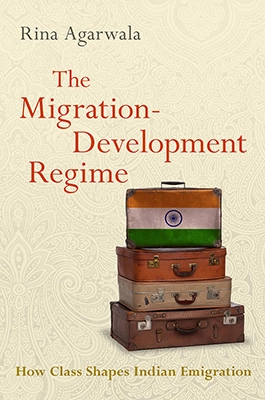
But as sociologists, we must not stop our inquiry here. In my recent book, The Migration-Development Regime: How Class Shapes Indian Emigration, I offer a new analytical framework that I call the migration-development regime, or MDR, that draws on our sociological tool kit to expand inquiry in three important ways.
Who benefits from migration regimes?
First, we must tap our sociological understandings of power to expose the non-migrant actors that not only lose but also benefit from migration. While the public and political controversies around migration have shown that migration clearly affects populations far beyond those that actually migrate, current debates tend to focus on the costs incurred. But highlighting exactly who among non-migrant populations are benefitting and how they benefit can better explain why migration flows continue despite the costs and risks involved. Highlighting these beneficiaries and the benefits may also help increase public support for migration. Finally, exposing these beneficiaries and benefits can help expose exactly which areas require protection.
So which non-migrant actors benefit from migration and how? In the case of global migration, we know that native employers often attain increased economic profit and race- and gender-based status mobility through cheap migrant labor in the paid productive sphere. Sociologists have also helped expose how native families attain increased race- and gender-based power in the paid and unpaid reproductive sphere by relying on migrants to care for their elderly, their young, and even themselves.
The MDR framework highlights another beneficiary that is too often occluded in sociological studies on migration: the state. Since the early 1900s, the “migration states” of receiving and sending countries have controlled who enjoys the right to enter or leave particular national borders. And despite the proliferation of interest in “transnationalism,” nation states still serve as the sole actor with the legitimate authority to regulate, restrict, and govern the cross-border movement of people. But such governance is costly. So why would states bother? Drawing on the case of India as a sending state from 1833 to the present, I demonstrate how the Indian government has consistently used out-migration as a vector through which to attain economic growth at home, secure political legitimacy (at the domestic and global levels), and attain consent for new norms, habits, and practices. For example, Indian emigrants helped spread the anti-imperialist and anti-racist movement of the early 1900s and a pro-democracy movement in the 1970s. And more recently, poor migrant workers who circulate between India and the Gulf transmit ideals of entrepreneurship and self-sufficiency and formulate identities of global cosmopolitanism.
But important questions remain to be answered in future research. Increasingly, states are simultaneously serving as sending and receiving states. How do they manage these competing roles? How do national-level state regimes differ from and potentially clash with sub-national state regimes? Relatedly, does the MDR framework call on us to break down the current silos separating domestic-level and international-level migration analyses?
What are the exact consequences of migration regimes?
Second, by highlighting the exact beneficiaries of migration, we can also more accurately expose the exact consequences (intended and unintended) of migration; which in turn can better highlight the exact nature of the problems we need to solve.
In the case of India, I use the MDR framework to argue that a key consequence of the Indian state’s emigration policies and practices from the 1830s to the present has been to consistently exacerbate and cement class-based inequities between Indian citizens. For example, in the wake of its 1833 abolition of slavery, the British colonial regime encouraged the emigration of poor Indian workers to serve as racialized coolies (in indentured servitude, informal employment, and middle-class professional jobs). But since the 1900s to the present day, the Indian government has legally restricted poor citizens from emigrating abroad, while allowing elite citizens to move freely. While these restrictions on mobility were implemented in the name of protection and nationalism, they offered what I call “paternalist protection,” which in turn has deepened class inequalities within India and globally.
Meanwhile, since the 1980s, the Indian state has enabled its elite emigrants to form what I call an “elite pact” with business and government leaders in India, which in turn has shifted India’s position in the global capitalist order for the first time since the 1800s. Due to the Indian state’s emigration policies and practices, Indian-Americans, in particular, have served as a key transnational vector for the transmission of neoliberal ideals and practices of privatization, self-sufficiency, and voluntarism from elite US spaces to elites in India. This has reshaped Indian businesses, civil society organizations, education, healthcare, tax codes and real estate markets, making India a new type of global economic actor. The UK’s Indian-origin, Hindu ex-prime minister exemplified how such transnational vectors also bleed into the intimate sphere; he is married to an Indian citizen and daughter of the founder of one of India’s most successful IT firms.
But, again, important questions remain to be answered. If the MDR framework exposes class-based inequities, should it also be able to expose the caste- and gender-based consequences of migration regimes? How have migration states cemented these hierarchies over time?
How can and do migration regimes change?
Finally, as sociologists we are well-trained on the complicated and dynamic relationship between structure and agency, and we know that power can be exerted from above and below. Therefore, the MDR framework conceptualizes the migration state not as a static entity, but as a site of struggle. In our migration research, therefore, we must not only show how political and economic structures shape migration from above, we must also show how migrants sometimes reshape states and economic structures from below. As a result of this dialectical relationship between states and migrants, MDRs change over time. In the case of India, my book traces the rise and fall of three distinct MDRs from the 1830s to the present. Future research should trace the historical shifts that have occurred in the MDRs of different countries, and sub-national regions, and use these histories to envision alternative futures.
Sociologists have been making important contributions to our understanding of global migration for decades. But contemporary challenges are taking new turns, and our research needs a breath of fresh air. The MDR framework offers one new tool to help expand our future research.
Rina Agarwala, Johns Hopkins University, USA <agarwala@jhu.edu>