
Chinese Education Migrants at Home, Abroad and Returned
March 20, 2026
Many young Chinese migrants seek social advancement through better education. This study considers internal and international education migrants, as well as “returnees”. The research emphasizes their lived experiences in seeking local residency status: Shanghai or Beijing hukou (household residency), and permanent residency (PR) in Canada. While Canadian citizenship may be functionally closer to hukou than PR is, citizenship barely registered among my interviewees; voting rights go unmentioned, and Canadian citizenship otherwise merely complicates visits or future return to China.
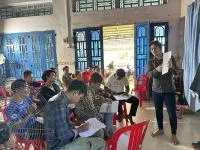
From 2024 to 2025, I interviewed twelve Chinese education migrants in British Columbia, Canada, and fifteen in Beijing and Shanghai, China. Most were born in the 1990s; few were married; most were women; each was employed or seeking work.
Why combine the groups in one study? Firstly, “bordering practices” of inclusion and exclusion take place both at national borders and within national territories. Secondly, internal and international migration experiences overlap. And finally, the link between education and social mobility isn’t smooth.
Fluid, overlapping migrant experiences
My interviews upset neat oppositions between migrants at “home” and “abroad.” All but three “internal migrants” had also “returned” after studying overseas, but none had returned to their hometown. Meanwhile, several “returnees” in Beijing or Shanghai considered these locations to be temporary too, though all considered these cities cosmopolitan, developed, and desirable oases.
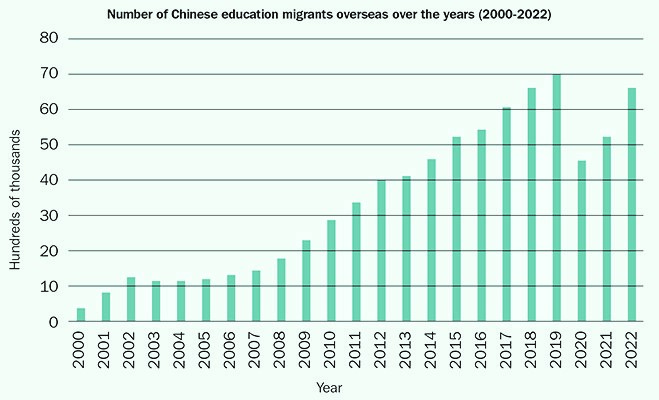
Most interviewees in Canada wanted to stay, but even those with permanent residency traveled back to visit China-based relatives and friends, and some actively planned permanent return when their parents aged. (A recent study showed over 80% of education migrants worldwide return.) Overall, education migrant experiences proved provisional, fluid, overlapping, and messy.
Spatial inequalities and education mobility
My respondents grew up in a hypermobile, reform-era China. The spatial mobility supporting their aspirations reflects sharp geographic inequalities. It depends on looser hukou and passport policies in China, receptive talent-recruitment policies of host governments, and improved, cheaper transport and communication (bullet trains, air travel, social media).
As these education migrants moved, wider migration pressures often changed their hometowns. Deindustrialization in China’s northeast closed factories and forced out-migration. Market- and state-driven urbanization fundamentally altered the social fabric elsewhere. Labor migrants often build new houses for relatives back home. Hometowns are remembered for denser social relationships, but as places left behind.
Preferences for Beijing and Shanghai were likely shaped by the study’s recruitment criteria, but they are unsurprising. Shanghai or Beijing hukou holders have easier access to top Chinese universities at home. By contrast, top rural or small-town migrants like my respondents moved, and often boarded, normally for junior high school at minimum.
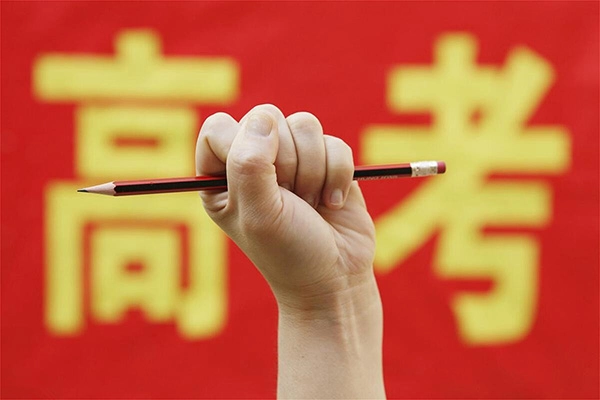
Preparation for gaokao (the national college entrance exam) was all-consuming; it required immense invisible and undervalued supports: paid workers at boarding schools, or parents, mostly mothers. Those not boarding might rent accommodation near school with paid or parental support work, but they still spent most waking hours at school. Secondary students who had traveled to study were thus relatively immobile for years during study. Entering a top Beijing or Shanghai university was therefore already a success story.
Many Canada-based interviewees also began their education migration in secondary school, mirroring the trajectories of internal migrants in China. Yet, unlike the prestige attached to entering a top university in Beijing or Shanghai, enrolling in a Canadian university is a far less clear marker of success. Many four-year undergraduates either did poorly in the gaokao or wanted to avoid it. Only a middle-class or wealthy family can afford the full education costs in British Columbia, Canada. Poorer British Columbia-based graduate students therefore often work while attending school. Cost and immigration potential led my respondents to Canada. Beyond class climbing, therefore, respondents often cited personal development as a reason to migrate to Canada.
Bordering practices and strategizing for permanent local status
Lower-skilled labor migrants in China do not have the same hopes for upward social mobility as education migrants do. Local hosting governments in China want cheap migrant labor, but not as permanent hukou holders. While less important today, hukou still offers some key lifetime entitlements, including education rights for future children.
By contrast, successful education migrants enjoy a relatively privileged route to local hukou. But they still face multiple barriers at top Chinese universities and cities. Even when they succeed, big-city hukou holders mock the skills and exceptionally high exam scores of the migrants who succeed.
Unlike education migrants in Canada, Chinese education migrants can legally remain in Beijing or Shanghai without local hukou after graduation. They need only secure jobs and accommodation. Interestingly, because access to Beijing hukou only privileges state employees, it is not a priority for those aiming for employment in the private sector. Unlike low-skilled migrants, they know good private-sector jobs, not hukou, will provide them with private health insurance and pensions. Local hukou status matters mostly to migrant graduates with children, and many of my interviewees had other plans.
For Chinese education migrants in Canada, by contrast, permanent residency is crucial to any long-term stay, whether for job prospects, romantic ties, or to escape sexualized violence. On paper, “international students” do gain a distinct path to permanent residency under Canada’s International Mobility Program. However, lived experiences of that path were complicated. Frequent changes in Canada’s points system and recent intake reductions can jeopardize well-laid permanent residency plans. Also, to earn extra points towards an invitation to apply for permanent residency, interviewees often worked in local, low-skilled, and precarious jobs. Between graduation and a permanent residency application invitation, initial Canadian work experience can also be crucial to later, more permanent jobs. All but one interviewee found their first local job at Chinese-owned businesses, few of which require Canadian work experience. Some of the employers themselves were recent migrants. Common jobs include specialty services to the local Chinese community, including student educational and immigration services or restaurant work.
Conclusion
Research on international and internal migration both have a bearing on these education migrant experiences. Combining studies, national borders are not central among the important barriers migrants face, including power inequalities. Chinese hukou divides rural from urban, and towns and cities of differing status; but also low-skilled from educated. Canadian permanent residency, not ultimately citizenship, leads education migrants into precarious employment, commonly in community businesses. Moreover, unstable rules of the game complicate their quest for stable local status.
Feng Xu, University of Victoria, Canada <fengxu@uvic.ca>