
The Distinct Pull of Dubai for Non-Western Expatriates
March 20, 2026
Since Saskia Sassen’s classic work describing New York, London, and Tokyo as global cities, other global cities have been identified and ranked largely using economic criteria. As nodes of corporate globalization, global cities are home to the offices of leading multinational corporations run by highly skilled migrants. As these cities vie for such talent, the analysts who assess and rank them, and even the policymakers who try to promote them, tend to use universal criteria as if all expatriates fit the same mold of seeking only high incomes, comfortable lifestyles, and greater safety. Even the cultural significance of global cities is assessed in terms of the number of museums and landmarks they host.
We ask if there are additional “distinct” aspects of a global city that can increase its appeal to specific subgroups of high-skilled migrants. To answer this question, we consider the case of Dubai, which has quickly risen in global city rankings. Drawing on surveys and in-depth interviews with non-Western migrant professionals in Dubai, we find that Dubai holds a distinct appeal as both a global city and a “local” city for expatriates from the South Asia and Middle East and North Africa (MENA) regions.
As a typical global city, Dubai offers (1) increased economic benefits, (2) higher living standards, and (3) greater safety that migrants often associate with the constructed category of the Global North. But Dubai also offers “local” benefits to these migrants: (4) geographic proximity to their origin countries, (5) cultural familiarity, given its large and long-standing migrant populations from these regions, and finally (6) greater tolerance for these migrants’ specific religious and racial identities.
Background to Dubai
A city of 3.5 million, Dubai is the largest city in the United Arab Emirates (UAE). Over the last two decades, Dubai has rapidly developed into the preferred regional headquarters location for multinational corporations operating in the MENA region. The city prides itself on being the most business-friendly and liberal hub within the Middle East and consistently receives high scores for its public safety, trust in government, and livability, some of the standard criteria used to rank the expatriate-friendliness of cities.
Meanwhile, Dubai (and the rest of the UAE) remains heavily dependent on migrants to sustain its economic growth. In 2023, 92% of Dubai’s population was non-Emirati. While the popular image of expatriates in Dubai is of Westerners, many more are, in fact, from South Asia and MENA.
A different kind of expatriates
To assess the relative appeal of Dubai, we surveyed and interviewed high-skilled migrants from the three world regions directly surrounding the UAE (South Asia, MENA, and Sub-Saharan Africa). We considered North African countries within MENA and separate from the rest of Africa because people from these countries speak Arabic and are viewed as ethnically Arab.
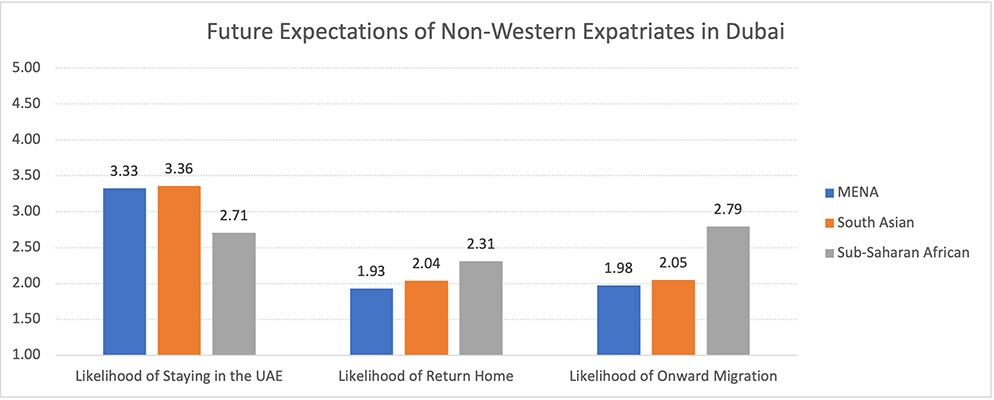
Our survey data revealed that all three respondent groups had a strong desire to move to the UAE prior to their migration (averaging 3.68 on a 5-point scale from 1 to 5). But South Asian and MENA respondents expressed a much stronger desire to stay on in the UAE, compared to Sub-Saharan African migrants (3.35 versus 2.71). This divergence was linked to differing levels of satisfaction across the three groups when comparing their life in the UAE with their life in their previous country.
While South Asian and MENA respondents saw significant improvements upon arrival in the UAE on three key fronts – career, living standards, and cultural familiarity – Sub-Saharan African respondents only reported a significant improvement on the work and living standards fronts, but not for cultural familiarity, due to the smaller size of Sub-Saharan African communities. Consequently, Sub-Saharan African respondents were more interested in moving onward out of the UAE to a third country, compared to the other two groups.
Dubai’s economic, lifestyle, and safety benefits
Our in-depth interviews with 46 of these globally mobile professionals who had resided outside their home country before coming to Dubai helped unpack these differing viewpoints. All three groups highlighted the economic benefits, comfortable lifestyle, and greater safety they enjoyed in Dubai. These benefits are applicable to all skilled migrants working as expatriates in the UAE, regardless of their origin country. The financial benefits that Dubai provides expatriate professionals can sometimes even surpass their income from comparable positions in Western countries, partly thanks to the UAE’s low value-added tax and lack of personal income tax.
Interviewees highlighted Dubai’s high living standards, including a well-maintained public infrastructure and a sense of greater public safety. In addition, they emphasized their easy access to affordable domestic labor, thanks to the large volume of low-wage labor migrants from Asia and Africa who also flow into the UAE seeking employment in care work and service work. These characteristics speak to the bona fide “global city” status of Dubai, with its significant populations of migrants at both the high and low end of the labor market.
Dubai as the best of both worlds
But South Asian and MENA interviewees also spoke at length about Dubai’s geographic proximity to their origin countries, enabling them to enjoy frequent (and affordable) visits to family back home or for their relatives to visit them through the UAE’s lax tourist visas. Given the long-standing populations of middle-class migrant communities from these two regions in the UAE, and the various cultural and social institutions that have developed alongside these communities, South Asian and MENA expatriates often highlighted Dubai’s cultural familiarity, mentioning the various amenities (from mosques, to supermarkets and restaurants offering halal and ethnic food options, to schools teaching their national curriculum) that help make Dubai feel “like home” to them.
Finally, these interviewees spoke of the greater acceptance of their religious and racial identities, something they often lacked in the global cities of the North. In contrast, Sub-Saharan African interviewees were more likely to speak of racial discrimination in the UAE, or simply loneliness because of the absence of a large co-ethnic community at the same class status.
Overall, our findings highlight the need for global/world cities scholarship to consider the diversity of skilled migrants in these cities, rather than assuming a universal expatriate. There should be greater acknowledgement of cities’ social and cultural characteristics, beyond facile notions of cosmopolitanism, in making select migrant groups feel “at home” abroad.
Anju Mary Paul, New York University Abu Dhabi, UAE <anju.paul@nyu.edu>
Mustafa Yavaş, New York University Abu Dhabi, UAE <mustafa.yavas@nyu.edu>
Sejin Park, New York University Abu Dhabi, UAE <sejin.park@nyu.edu>