GD 10.1 - April 2020
Global Dialogue is available in multiple languages!
Select the language to download the issue.
Editors:
Brigitte Aulenbacher, Klaus Dörre.
Assistant Editors:
Johanna Grubner, Christine Schickert.
Associate Editor:
Aparna Sundar.
Managing Editors:
Lola Busuttil, August Bagà.
Consultants:
Michael Burawoy.
Media Consultant:
Juan Lejárraga.
Consulting Editors:
Sari Hanafi, Geoffrey Pleyers, Filomin Gutierrez, Eloísa Martín, Sawako Shirahase, Izabela Barlinska, Tova Benski, Chih-Jou Jay Chen, Jan Fritz, Koichi Hasegawa, Hiroshi Ishida, Grace Khunou, Allison Loconto, Susan McDaniel, Elina Oinas, Laura Oso Casas, Bandana Purkayastha, Rhoda Reddock, Mounir Saidani, Ayse Saktanber, Celi Scalon, Nazanin Shahrokni.
REGIONAL EDITORS
Arab World: (Tunisia) Mounir Saidani, Fatima Radhouani, Habib Haj Salem; (Algeria) Souraya Mouloudji Garroudji; (Morocco) Abdelhadi Al Halhouli, Saida Zine; (Lebanon) Sari Hanafi.
Argentina: Alejandra Otamendi, Juan Ignacio Piovani, Martín Di Marco, Pilar Pi Puig, Martín Urtasun.
Bangladesh: Habibul Haque Khondker, Hasan Mahmud, US Rokeya Akhter, Juwel Rana, Toufica Sultana, Asif Bin Ali, Khairun Nahar, Kazi Fadia Esha, Muhaimin Chowdhury, Helal Uddin, Md. Eunus Ali, Mostafizur Rahman, Jhilik Saha, Maria Sardar, Tahmid Ul Islam.
Brazil: Gustavo Taniguti, Angelo Martins Junior, Lucas Amaral Oliveira, Andreza Galli, Dmitri Cerboncini Fernandes, Gustavo Dias.
France/Spain: Lola Busuttil.
India: Rashmi Jain, Nidhi Bansal, Pragya Sharma, Manish Yadav, Sandeep Meel.
Indonesia: Kamanto Sunarto, Hari Nugroho, Lucia Ratih Kusumadewi, Fina Itriyati, Indera Ratna Irawati Pattinasarany, Benedictus Hari Juliawan, Mohamad Shohibuddin, Dominggus Elcid Li, Antonius Ario Seto Hardjana, Diana Teresa Pakasi, Nurul Aini, Geger Riyanto, Aditya Pradana Setiadi.
Iran: Niayesh Dolati, Abbas Shahrabi, Sayyed Muhamad Mutallebi, Faezeh Khajehzade.
Japan: Satomi Yamamoto.
Kazakhstan: Aigul Zabirova, Bayan Smagambet, Adil Rodionov, Almash Tlespayeva, Kuanysh Tel, Almagul Mussina, Aknur Imankul.
Poland: Adam Müller, Jonathan Scovil, Aleksandra Biernacka, Jakub Barszczewski, Aleksandra Wagner, Sara Herczyńska, Monika Helak, Aleksandra Senn, Weronika Peek, Anna Wandzel, Zofia Penza-Gabler, Justyna Kościńska, Iwona Bojadżijewa.
Romania: Raluca Popescu, Raisa-Gabriela Zamfirescu, Diana Alexandra Dumitrescu, Iulian Gabor, Bianca Mihăilă, Alexandra Mosor, Mioara Paraschiv, Maria Stoicescu.
Russia: Elena Zdravomyslova, Anastasia Daur, Valentina Isaeva.
Taiwan: Wan-Ju Lee, Bun-Ki Lin, Tao-Yung Lu, Po-Shung Hong, Yu-Min Huang.
Turkey: Gül Çorbacıoğlu, Irmak Evren.
GD 10.1 - April 2020
Editorial
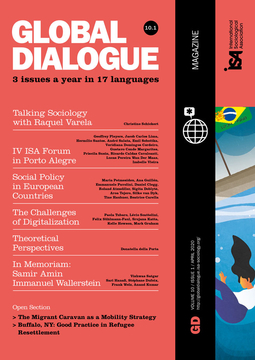
In this issue’s interview, labor historian Raquel Varela looks back at Portugal’s Carnation Revolution of April 1974. She discusses why it is important to tell world events “from below,” taking up working people’s perspectives and contributions and addresses the lasting impacts of the revolution left in Portugal’s social and economic fabric.
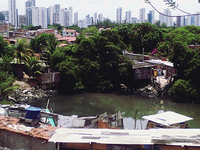
In July 2020, sociologists and social scientists from all over the world will participate in the IV ISA Forum of Sociology in Porto Alegre, Brazil to discuss their research and perceptions on social transformations in light of four main challenges of the 21st century: democracy, environment, inequalities, and intersectionality. In his article Geoffrey Pleyers, President of the Forum stresses the importance of analyzing the interconnectedness of these social developments. Jacob Carlos Lima, President of the Brazilian Sociological Society (SBS) gives us a brief insight into the Society’s history and calls upon the support and solidarity of the sociological community in the face of the recent political developments in the country and the related social struggles. Hermílio Santos, André Salata, and Emil Sobottka, from the Forum’s Local Organizing Committee, as well as six young Brazilian scholars give us some insights into Brazilian history and sociology.
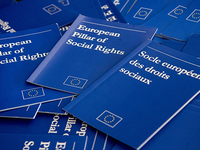
Due to the systematic dismantling of European welfare states in recent years, new forms of social policies have been set in place, challenging not only different countries in specific areas but the social pillar of Europe and the European Union. In our first symposium of this issue scholars present their research on current trajectories and the challenges faced by some European countries.
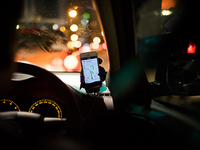
The second symposium takes up one of the big issues of our times: the digitization of society, looking at its impact on labor, financial markets as well as sustainability. The symposium also addresses how research can contribute to maintaining or creating workers’ rights and fair working conditions in the platform economy.
In her article, Donatella della Porta maps out the current challenges for social movement studies. In her view, ongoing protests around the world have brought new issues onto the agenda, but also demand new ways of analyzing them. She argues for bringing capitalism and class as analytical categories back into social movement studies.
With Samir Amin (1931-2018) and Immanuel Wallerstein (1930-2019), two leading social scientists and political thinkers have passed away. Amin’s strategic conception of delinking and critique of Eurocentrism influenced Marxists and social scientists around the globe. With his notion of world-system analysis Wallerstein enriched sociological theory in profound ways. As former President of the ISA, he established a flourishing exchange between old and new members that resonates to this day. Colleagues and friends of these two outstanding members of our community remember and honor their work and life.
The two articles featured in the Open Section deal with migration to the United States: Veronica Montes examines the so-called “migrant caravan” as a strategic choice for people wanting to migrate from Latin America to the north. Ayşegül Balta Ozgen introduces us to the challenges as well as the benefits refugee resettlement means for a midsize American city like Buffalo, NY.
Brigitte Aulenbacher and Klaus Dörre, editors of Global Dialogue.
Global Dialogue can be found in multiple languages.
Submissions should be sent to globaldialogue@isa-sociology.org.