
Ethnicity in Iran: The Question Iranian Sociology Avoids
March 20, 2026
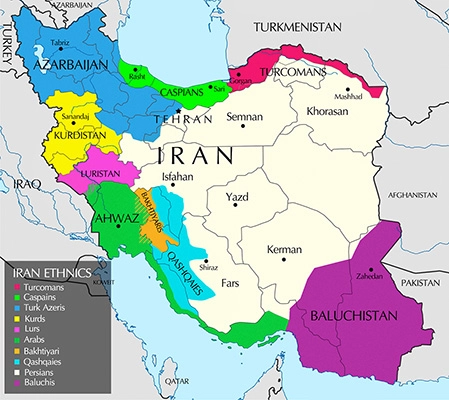
Ethnicity in Iran is an elephant in the room – at least when it comes to mainstream sociology. Iran is home to several ethnic groups, including Persians, Kurds, Turks, Arabs, and Baluchis. Persians constitute the majority in the central plateau, while other ethnic groups are concentrated in peripheral regions. These ethnic divisions intersect with religious differences, as Shia Islam is predominant in the center, and Sunni populations are more prevalent in peripheral regions. Even this brief description raises sociological questions, such as how such ethnic and religious differentiations and intersections shape social experiences. Yet, surprisingly, within the scholarship on Iran, these fragmentations are overlooked.
This is not to deny the growing body of literature on ethnicity, which I will explore later, but in general sociological studies, ethnicity is largely denied as an analytical category that differentiates social experiences in Iran. There are studies after studies being published examining a variety of themes, from the Iranian revolutions to women’s struggles, social movements, subaltern politics, and other sociopolitical challenges the country faces. However, in much of this literature, the subject remains a singular “Iranian people,” while ethnicity is muted.
The denial, on the one hand, stems from nationalist perspectives that portray Iran as a historically unified and homogeneous nation. Ethnicity, thus, is seen as a matter of cultural variations rather than a structuring dimension of social experience. This view often draws on narratives of a glorified ancient Iran as well as myths of Aryan descent to naturalize the national unity and reject the existence of national fragmentation. Within this framework, including ethnicity as an analytical axis for understanding everyday realities in the country is deemed irrelevant and even dangerous, as acknowledging ethnicity is feared to solidify such distinctions, fracturing what is imagined to be a unified whole.
Critical scholars are more likely to acknowledge the modern construction of the nation. The majority of them recognize that Iran is not exceptional in the global history of nation-state formation. However, within this tradition, ethnicity has received little attention as a structuring dimension of Iranian sociopolitical life, although some recent work has begun to address this gap. For instance, a recent paper by Kadivar et al. (2025) incorporates ethnicity as a dimension in analyzing recent waves of protest in Iran. Yet this approach remains marginal.
This analytical silence is not accidental but rooted in the positionality of Iranian sociology itself. The field has historically been shaped by Persian, Shia, and middle-class intellectual traditions. This tradition tends to equate the nation with the culture, language, and historical experience of Iran’s central plateau, thereby overlooking the possibility of different social realities. This becomes more significant when we consider the intersection of ethnicity and religion, as large peripheral populations are both Sunni and non-Persian. It is also important to keep in mind that peripheral communities have experienced different trajectories in their relationship with the central Iranian state. The formation of the modern Iranian state, for example, that is widely celebrated as the birth of the modern Iranian nation and its territorial integrity in the center, is remembered in peripheral regions as the loss of autonomy. The same can be said about the Islamic Revolution of 1979, when the emphasis on Shiism triggered resistance and violent repression in the periphery. Of course, the list could go on and on. But the point remains that how these views from the edge, to use Iranian historian, Arash Khazeni’s words, remain largely absent in this scholarship. The problem here is not that these perspectives are difficult to reconcile, nor is it simply a lack of personal willingness to see the social world through the eyes of those on the margins. The issue, rather, is that the view from the periphery remains largely unthinkable from a standpoint deeply entrenched in the center. Underlying all of this, of course, are deeper power relations, which I set aside for now.
Ethnicity in Iran is usually framed as a pathology rather than as an axis of inequality
Despite this broader analytical silence, scholarship on ethnicity in Iran has developed as a narrow, separate, yet growing field. Within the country much of the research on ethnicity adopts a policy-oriented, pathological lens. Ethnicity is framed as a “problem,” an existential threat to national integrity that must be monitored, contained, or neutralized. Researchers move across ethnic groups as if investigating risk zones. They constantly assess levels of national identity, evaluating how ethnic affiliations align with or diverge from national ones, and whether it constitutes a threat at this time.
Topics such as separatism, national cohesion, and ethnocentrism (qawmgerayi) dominate the field. Some studies deny the very existence of ethnicity in Iran, portraying it as a myth manufactured by elites or foreign actors intent on destabilizing the nation. Others treat it as an unfolding crisis: a latent threat to sovereignty, a “security illness” (bimaari-ye amniati) to be diagnosed and treated, a flashpoint for future conflict, or a security challenge that should be managed. This is, indeed, a sociology that “sees like a state,” to borrow James Scott’s phrase, seeking to make ethnic populations legible and manageable for the purposes of control, rather than to understand them on their own terms.
Alongside this, a more critical and interpretive body of work has emerged, analyzing how ethnic policies have been shaped by broader state-building projects. Rather than framing ethnicity as a pathology to be managed, this scholarship situates ethnic identity within the historical processes of nation-building, coercive integration, and uneven development. Works in this tradition examine how state discourses and institutions have produced marginalization through mechanisms such as linguistic homogenization, the suppression of minority histories, and securitization of non-Persian communities. Some scholars have also highlighted forms of everyday resistance: how ethnic minorities negotiate, subvert, or contest dominant narratives of national identity. There is also a growing, though still limited, body of empirical research that has begun to explore ethnic disparities in education, healthcare, and economic opportunities, raising the challenging yet still largely unanswered question of whether ethnicity functions as an axis of inequality in contemporary Iran.
Ethnicity is entangled with long-standing struggles
Important gaps still remain. The first is conceptual: ethnicity remains elusive within the Iranian context, leading some scholars to substitute terms like “minority” to avoid political and theoretical tensions. “Minority” generally refers to numerical marginality or structural subordination, but is less concerned with contentious questions such as how to define an ethnic group, where to draw its boundaries, or how to avoid essentializing identities. This shift allows scholars to pursue what Rogers Brubaker calls “ethnicity without groupism” (as seen in Elling’s work), which may enable analysis of marginalization without invoking collective identity claims or challenges to sovereignty.
Yet, the question persists: what does “ethnicity” – even when framed more cautiously as “minority” – actually mean in the Iranian context? This becomes especially more important when applying Western frameworks without sufficient critique, theories which often emphasize identity, cultural difference, or symbolic boundaries, but pay far less attention to the historical question of sovereignty. In Iran, ethnicity is not simply about cultural distinctiveness. It is entangled with long-standing struggles over state sovereignty, territorial control, and forced incorporation of peripheral regions. The country’s major ethnic groups – Turks, Kurds, Baluchis, Arabs, and Turkmen – are concentrated in what is commonly called the “periphery”: regions geographically distant from Tehran and the central plateau. These regions and their communities often had their histories of semi-autonomous rule and longstanding tensions with the central state: regions whose incorporation into the political body of the Iranian state entailed military campaigns, forced assimilation, and population control. Yet these histories are often excluded from contemporary analyses of ethnicity, making it difficult to grasp the full complexity of ethnic dynamics today.
Integrating tribal histories into the sociology of ethnicity reveals how historical legacies shape current realities
To be sure, the state’s expansion into the periphery has been documented – particularly in literature influenced by subaltern studies. These works trace state violence and local resistance, typically framed as “tribal politics.” However, studies of tribal politics and ethnicity have remained siloed: the former relegated to history, the latter to the present. This division obscures how historical legacies shape current realities. Bridging this gap would open new conceptual horizons for ethnic studies in Iran.
A small but growing body of scholarship is beginning to do just that. Drawing on peripheral histories of state formation, these works question the nature of the Iranian state itself. They examine episodes of forced displacement, cultural erasure, and state violence, arguing that state formation involved not just modernization but also logics of colonial domination. From this view, Iran’s expansion into its ethnically distinct peripheries resembles a settler colonial project, and resistance to it constitutes decolonial praxis. This reframing unsettles dominant paradigms and demands the integration of tribal histories into the sociology of ethnicity.
The censored need for empirical research which recognizes the multiplicity of lived experiences
Still, understanding ethnicity – regardless of theoretical framing – requires empirical grounding. It must be studied as a lived, negotiated, and situated phenomenon shaped by everyday practices and contested meanings. This calls for long-term ethnographic engagement. Yet such research is severely constrained in Iran by political and structural barriers. The securitization of ethnicity has created a climate of fear and self-censorship. Researchers and interlocutors alike risk accusations of separatism or acting against national security. Fieldwork becomes fraught, and institutions are unlikely to support research that challenges dominant narratives.
Centering ethnicity compels Iranian sociology to confront its exclusions, challenge dominant national imaginaries, and recognize the multiplicity of lived experiences. It also invites a more grounded understanding of the Iranian state – one shaped not only by revolution and ideology but by contested geographies, peripheral histories, and struggles over sovereignty.
Aghil Daghagheleh, University of Northern Colorado, USA <aghil.daghagheleh@unco.edu>