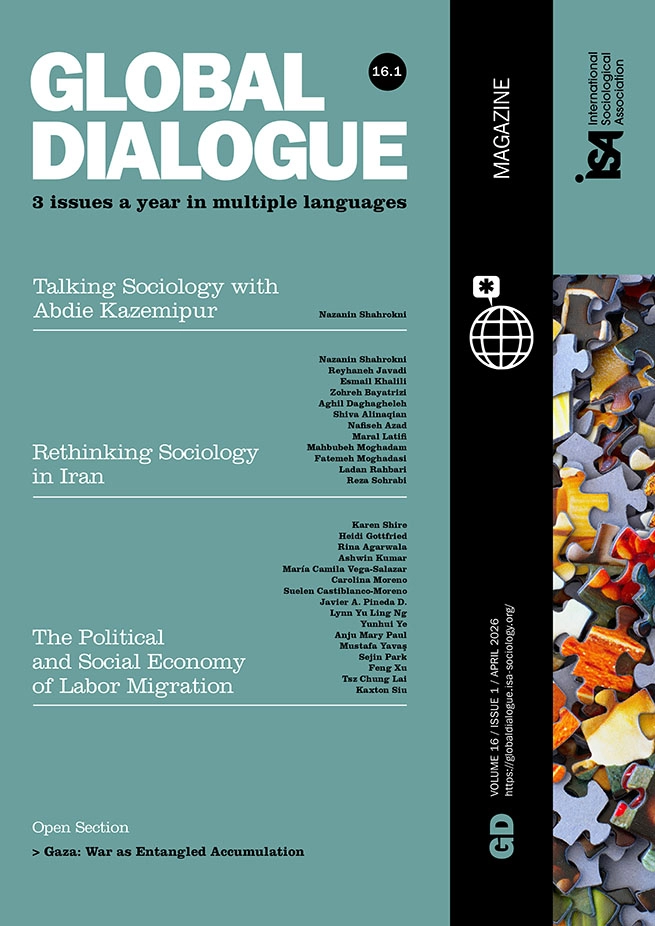
GD 9.1 - April 2019
Global Dialogue is available in multiple languages!
Select the language to download the issue.
Editors:
Brigitte Aulenbacher, Klaus Dörre.
Assistant Editors:
Johanna Grubner, Christine Schickert.
Associate Editor:
Aparna Sundar.
Managing Editors:
Lola Busuttil, August Bagà.
Consultants:
Michael Burawoy.
Media Consultant:
Gustavo Taniguti.
Consulting Editors:
Sari Hanafi , Geoffrey Pleyers, Filomin Gutierrez, Eloísa Martín, Sawako Shirahase, Izabela Barlinska, Tova Benski, Chih-Jou Jay Chen, Jan Fritz, Koichi Hasegawa, Hiroshi Ishida, Grace Khunou, Allison Loconto, Susan McDaniel, Elina Oinas, Laura Oso Casas, Bandana Purkayastha, Rhoda Reddock, Mounir Saidani, Ayse Saktanber, Celi Scalon, Nazanin Shahrokni.
REGIONAL EDITORS
Arab World: Sari Hanafi , Mounir Saidani.
Argentina: Juan Ignacio Piovani, Alejandra Otamendi, Pilar Pi Puig, Martín Urtasun.
Bangladesh: Habibul Haque Khondker, Hasan Mahmud, Juwel Rana, US Rokeya Akhter, Toufi ca Sultana, Asif Bin Ali, Khairun Nahar, Kazi Fadia Esha, Helal Uddin, Muhaimin Chowdhury, Md. Eunus Ali.
Brazil: Gustavo Taniguti, Andreza Galli, Lucas Amaral Oliveira, Benno Warken, Angelo Martins Junior, Dmitri Cerboncini Fernandes.
France/Spain: Lola Busuttil.
India: Rashmi Jain, Pragya Sharma, Nidhi Bansal, Sandeep Meel.
Indonesia: Kamanto Sunarto, Hari Nugroho, Lucia Ratih Kusumadewi, Fina Itriyati, Indera Ratna Irawati Pattinasarany, Benedictus Hari Juliawan, Mohamad Shohibuddin, Dominggus Elcid Li, Antonius Ario Seto Hardjana, Diana Teresa Pakasi, Nurul Aini, Geger Riyanto, Aditya Pradana Setiadi.
Iran: Reyhaneh Javadi, Niayesh Dolati, Sina Bastani, Sayyed Muhamad Mutallebi, Vahid Lenjanzade.
Japan: Satomi Yamamoto, Sara Maehara, Masataka Eguchi, Riho Tanaka, Marie Yamamoto.
Kazakhstan: Aigul Zabirova, Bayan Smagambet, Adil Rodionov, Almash Tlespayeva, Kuanysh Tel, Almagul Mussina, Aknur Imankul.
Poland: Jakub Barszczewski, Katarzyna Dębska, Anna Dulny-Leszczynska, Krzysztof Gubański, Monika Helak, Sara Herczyńska, Justyna Kościńska, Łucja Lange, Iga Łazińska, Adam Müller, Weronika Peek, Zofi a Penza-Gabler, Jonathan Scovil, Marcjanna Szczepaniak, Agnieszka Szypulska, Anna Tomala, Mateusz Wojda.
Romania: Cosima Rughiniș, Raisa-Gabriela Zamfi rescu, Luciana Anăstăsoaie, Costinel Anuța, Maria Loredana Arsene, Diana Alexandra Dumitrescu, Radu Dumitrescu, Iulian Gabor, Dan Gîtman, Alecsandra Irimie-Ana, Iulia Jugănaru, Ioana Mălureanu, Bianca Mihăilă, Andreea Elena Moldoveanu, Rareş-Mihai Muşat, Oana-Elena Negrea, Mioara Paraschiv, Alina Cristina Păun, Codruţ Pînzaru, Susana Maria Popa, Adriana Sohodoleanu, Elena Tudor.
Russia: Elena Zdravomyslova, Anastasia Daur, Valentina Isaeva.
Taiwan: Jing-Mao Ho.
Turkey: Gül Çorbacıoğlu, Irmak Evren.
GD 9.1 - April 2019
Editorial
At the XIX ISA World Congress of Sociology in Toronto, Canada, this past July, Sari Hanafi was elected as the new President of the International Sociological Association. This first 2019 issue of Global Dialogue opens with Hanafi’s theoretical vision for the ISA in the course of his term. Here he argues for combining postcolonial and post-authoritarian approaches to lead a conversation around a new paradigm for pluralism in this age of multiple modernities.
Along with the rise of right-wing populist parties across the globe, sociological debates on class have gained new prominence. The first symposium of this issue reflects this newfound interest in questions of class formation and class relations around the world with contributions examining current research in Latin America, the United States, Germany, and Southeast Asia. In conjunction with this research, the symposium explores the implications for the rise of poverty and inequality.
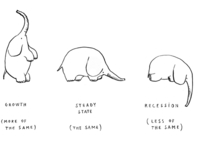
For decades, generating economic growth has been at the center of most economic activity as well as of policy initiatives and scholarly discussions. Over the last years, a growing number of activists, but also sociologists and economists have started an impressive debate on the limits of growth. They discuss the future, and in some regions the possible end, of permanently high growth rates as well as the ecologically and socially destructive effects of this one-sided focus on GDP growth. Both scholarly and activist debates also examine possible alternatives, and most prominently the idea of “degrowth,” a concept that has not remained unchallenged. The texts of the second symposium reflect the discussions surrounding the future of growth and a possible degrowth alternative.
Considering the contemporary global conjuncture, Ariel Salleh argues in her theoretical contribution for a new sociological class analysis that unites mothers, peasants, and gatherers in regard of their material skills in enabling life-on-Earth. With a historical reflection on the debates surrounding ecofeminism, she calls for a critical sociology and the notion of an embodied materialism.
The end of many of Latin America’s leftist governments coincides with the rise of right-wing, sometimes authoritarian governments in many other regions of the world. Here scholars from Brazil, Colombia, Turkey, and Poland examine the historical and political developments of right-wing populism.
Three articles are included in this issue’s Open Section: Johann Bacher, Julia Hofmann, and Georg Hubmann present the recently published doctoral thesis of Marie Jahoda and remind us what we, as social scientists and politically engaged citizens can learn from her life and work. Elísio Estanque and António Casimiro Ferreira give us an insight into Portugal’s new political-labor configuration under the most recent post-Troika period, while Global Dialogue’s Bengali Team introduce themselves and their work.
Brigitte Aulenbacher and Klaus Dörre, editors of Global Dialogue.
Global Dialogue can be found in multiple languages.
Submissions should be sent to globaldialogue@isa-sociology.org.