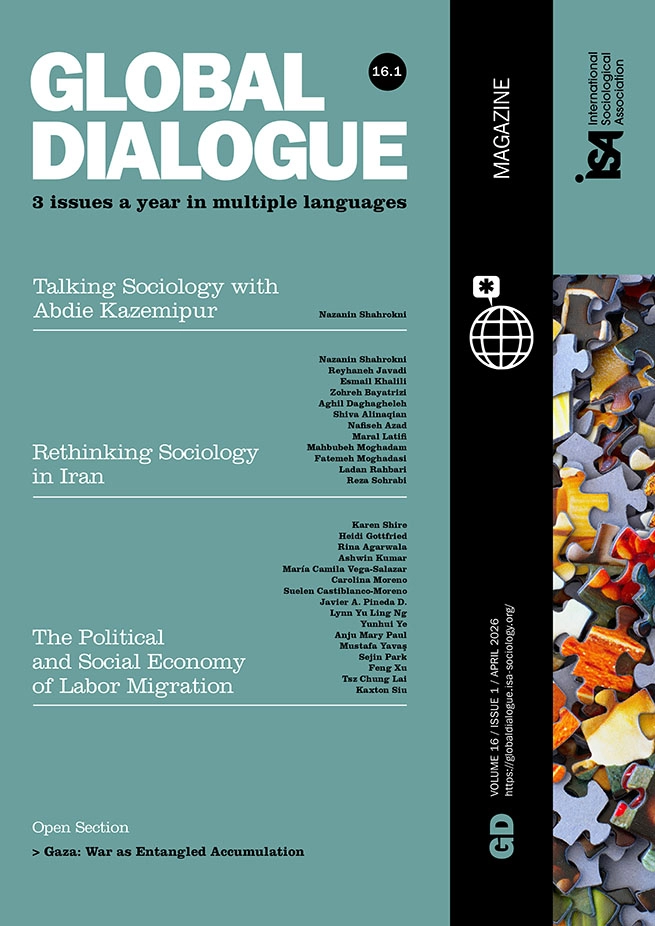
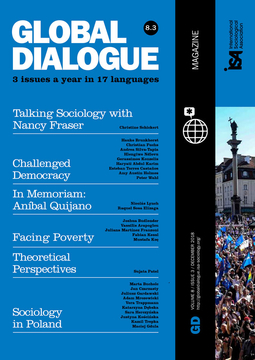
GD 8.3 - December 2018
Global Dialogue is available in multiple languages!
Select the language to download the issue.
Editors:
Brigitte Aulenbacher, Klaus Dörre.
Assistant Editors:
Johanna Grubner, Christine Schickert.
Associate Editor:
Aparna Sundar.
Managing Editors:
Lola Busuttil, August Bagà.
Consultants:
Michael Burawoy.
Media Consultant:
Gustavo Taniguti.
Consulting Editors:
Sari Hanafi, Geoffrey Pleyers, Filomin Gutierrez, Eloísa Martín, Sawako Shirahase, Izabela Barlinska, Tova Benski, Chih-Jou Jay Chen, Jan Fritz, Koichi Hasegawa, Hiroshi Ishida, Grace Khunou, Allison Loconto, Susan McDaniel, Elina Oinas, Laura Oso Casas, Bandana Purkayastha, Rhoda Reddock, Mounir Saidani, Ayse Saktanber, Celi Scalon, Nazanin Shahrokni.
REGIONAL EDITORS
Arab World: Sari Hanafi, Mounir Saidani.
Argentina: Juan Ignacio Piovani, Alejandra Otamendi, Pilar Pi Puig, Martín Urtasun.
Bangladesh: Habibul Haque Khondker, Hasan Mahmud, Juwel Rana, US Rokeya Akhter, Toufica Sultana, Asif Bin Ali, Khairun Nahar, Kazi Fadia Esha, Helal Uddin, Muhaimin Chowdhury, Md. Eunus Ali.
Brazil: Gustavo Taniguti, Andreza Galli, Lucas Amaral Oliveira, Benno Warken, Angelo Martins Junior, Dmitri Cerboncini Fernandes.
France/Spain: Lola Busuttil.
India: Rashmi Jain, Jyoti Sidana, Nidhi Bansal, Pragya Sharma.
Indonesia: Kamanto Sunarto, Hari Nugroho, Lucia Ratih Kusumadewi, Fina Itriyati, Indera Ratna Irawati Pattinasarany, Benedictus Hari Juliawan, Mohamad Shohibuddin, Dominggus Elcid Li, Antonius Ario Seto Hardjana, Diana Teresa Pakasi, Nurul Aini, Geger Riyanto, Aditya Pradana Setiadi.
Iran: Reyhaneh Javadi, Niayesh Dolati, Sina Bastani, Sayyed Muhamad Mutallebi, Vahid Lenjanzade.
Japan: Satomi Yamamoto, Sara Maehara, Masataka Eguchi, Riho Tanaka, Marie Yamamoto, Kaori Hachiya, Ayana Kaneyuki, Erika Kuga, Kaya Ozawa, Tsukasa Shibagaki, Michiaki Yuasa, Rikuho Baba.
Kazakhstan: Aigul Zabirova, Bayan Smagambet, Adil Rodionov, Almash Tlespayeva, Kuanysh Tel, Almagul Mussina, Aknur Imankul.
Poland: Jakub Barszczewski, Iwona Bojadżijewa, Katarzyna Dębska, Paulina Domagalska, Krzysztof Gubański, Sara Herczyńska, Justyna Kościńska, Łucja Lange, Adam Müller, Zofia Penza-Gabler, Anna Wandzel, Jacek Zych.
Romania: Cosima Rughiniș, Raisa-Gabriela Zamfirescu, Luciana Anăstăsoaie, Adriana Lavinia Bulumac, Cristian Chira, Denisa Dan, Diana Alexandra Dumitrescu, Radu Dumitrescu, Iulian Gabor, Alecsandra Irimie-Ana, Bianca Mihăilă, Andreea Elena Moldoveanu, Rareș-Mihai Mușat, Oana-Elena Negrea, Mioara Paraschiv, Alina Cristina Păun, Codruţ Pînzaru, Susana Maria Popa, Adriana Sohodoleanu, Elena Tudor.
Russia: Elena Zdravomyslova, Anastasia Daur, Valentina Isaeva.
Taiwan: Jing-Mao Ho.
Turkey: Gül Çorbacıoğlu, Irmak Evren.
GD 8.3 - December 2018
Editorial
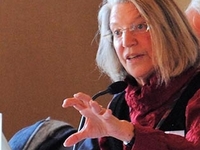
In many countries all over the world, democratic institutions and processes face increased challenges and pressure. Authoritarian tendencies can be observed in young and old democracies alike: a top-down leadership gains prominence again, nationalism soars, and civil society is weakened through the restriction of political rights. Women’s and minorities’ rights are particularly under attack. In the interview opening this issue of Global Dialogue Nancy Fraser, one of today’s most renowned and thought-provoking feminist thinkers, takes up some of the aspects of this development when she debates the question of building a more inclusive feminist movement and discusses her idea of a feminism for the 99%.
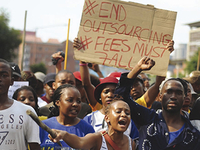
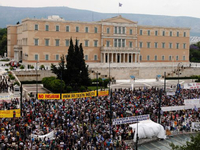
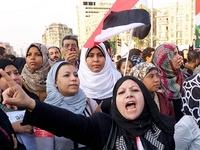
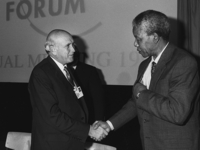
The articles of our first symposium on “Challenged Democracy” examine how democracy is under pressure in specific parts of the world, from the situation in post-apartheid South Africa to the politics of austerity threatening it in a country like Greece and the erasure of women’s contributions in accounts of the Egyptian Revolution. While the authors describe and analyze new developments such as the authoritarian turn in capitalism, they also evaluate concepts and ideas aimed at strengthening democratic processes.
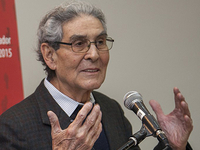
In May 2018, Aníbal Quijano, one of Peru’s and Latin America’s most eminent sociologists, passed away at the age of 87. His work on imperialism, colonialism, and his concept of the “coloniality of power” influenced generations of sociologists everywhere. Two of his close colleagues and friends look back at his life and celebrate his legacy.
For our second symposium entitled “Facing Poverty,” we gathered papers analyzing a variety of manifestations of poverty, ranging from the impact of austerity politics in Greece to the increasing number of poor women in Latin America despite a friendly political economy. Six authors from around the globe were invited to shed light on the specific regional developments of poverty and obstacles the policies against it are faced with.
In her article on global modernities Sujata Patel, a prominent sociologist from India discusses the nature and content of this theory of the globalizing world. She gives a historical and theoretical insight into this concept of multiple modernities and the critiques it draws on.
From the beginning, Polish thinkers have played an important role in developing sociology as a discipline and therefore this issue offers insights into its history in Poland. But it is not only its history that stimulated us to focus on this country but also its vivid sociology engaged today in many issues of our time. The articles introduce the readers to current research, like studies on young precarious workers, on the recent voting behavior of the Poles as well as on the changes in the Polish public sphere and their implications for sociology today.
Brigitte Aulenbacher and Klaus Dörre, editors of Global Dialogue.
Global Dialogue can be found in multiple languages.
Submissions should be sent to globaldialogue@isa-sociology.org.