Sociology as a Calling: T.K. Oommen and his Times
March 23, 2026
“To be authentic, sociology for one world should be utterly devoid of xenophobia and jingoism. This calls for the recognition of the assets in other cultures and civilization. The oneness of the world is to be reflected in its rich and variegated past and present, in its cultural diversity and pluralism.” (T.K. Oommen)
Remembering the ancestors of our discipline is an important part of our lives as academics; and remembering is also a political act, because many of those ancestors go unnoticed after their time. The month of February witnessed the loss of two towering sociologists in India; both of them, in many ways, shaped how we practice sociology as a discipline in the subcontinent: Prof. André Béteille (1934-2026) and Prof. T.K. Oommen (1937-2026). We need to remember these ancestors and how they contributed to making sociology an integral part of universities and public debates.
T.K. Oommen was a leading figure in Indian sociology, but also an important sociologist worldwide. He is internationally known because he was a president of the ISA. We also need to remember his sociology globally as it is highly relevant in our times when we are dealing with global crises such as ethnic divides, wars and deepening Islamophobia and cultural nationalism across the world. It is in this regard that we need to read and re-read Oommen’s rich body of work on understanding security, nationalism, social movements, caste, ethnicity, religion and globalisation, among other concerns.
Introducing a new culture of sociology in India while abandoning futile divides
When he started doing sociology in India, at the Poona University, the culture of sociology was dominated by the social anthropology tradition rooted in structural functionalism. In his interview with the sociologist Susan Visvanathan (2018), Oommen mentioned that he had the option to pursue his PhD with Irawati Karve (1905-1970), a leading anthropologist in Poona, but “accidental” and technical circumstances led him to work with Y.B. Damle, a Parsonian sociologist. At a time when Indian sociology focused on micro studies of caste, village, kinship, family and religion, Oommen decided for his PhD to study a social movement: the Bhoodan-Gramdan movement. He inaugurated a new culture of doing political sociology in India and contributed to adding social movements to the themes to explore in Indian sociology.
At the same time, Oommen engaged with the existing tradition of sociology of his time without compromising his own style of doing sociology. He mentions in his conversation with Susan Visvanathan (2018) that after joining Jawaharlal Nehru University (JNU) as a faculty member, the first course he taught was titled “Anthropological Monographs”. Throughout his career, he insisted on getting rid of the futile divide of sociology and social anthropology in India, and alerted us to the colonial past of both disciplines and what they can learn from each other conceptually and methodologically.
An “accidental” calling that led to major academic contributions in India and worldwide
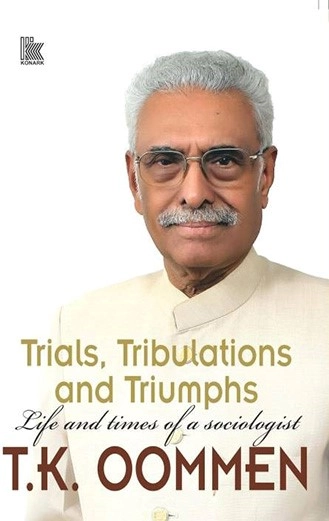
T.K. Oommen’s research themes range from social movements to professions – he wrote on nurses, doctors, lawyers and Christian clergy; and he supervised PhDs on various professions. I belong to a generation of sociologists who did not have direct interaction or personal connection with T.K. Oommen, unlike those we learnt from. The occasional lectures of his that we attended as graduate students at JNU were engaging and witty in nature. He was generous and supportive. In 2018, he published his memoir Trials, Tribulations and Triumphs: Life and times of a sociologist, which remains a major source for scholars working on the history of sociology in India and globally. The second part of his memoir, From Bharat to India: An Academic’s Journey, released in 2022, provides more space for some of his fieldwork experiences, notably in rural Rajasthan and Kerala.
For T.K. Oommen, sociology was a calling; although it was an “accidental” entry as he would often remind us. In his long career as a sociologist and social theorist, not only did he contribute to and help institutionalise sociology in India, but he also made his presence felt in the international sociological community. May his soul rest in peace!
Renny Thomas, Indian Institute of Science Education and Research (IISER) Bhopal, Madhya Pradesh, India <renny@iiserb.ac.in>